Showing posts with label exercise. Show all posts
Tuesday, October 31, 2017
Halloween Workout
Happy Halloween Ghouls and Ghosts!
I've put together a super spooky workout for you. Click the exercise name for a video on how to do it!
Repeat 3-5 total rounds
Frankenstein Walks: 8 Each side
Spiderman Exercise: 8 on each side
Seesaw Shredder: 20 seconds
Deadlift: 8
Rising From the Grave (Straight Leg Sit Up): 8
Atomic Push Up: 8
Face Pull: 8
I know this is a bit punny, I hope you enjoy!
Sunday, July 23, 2017
ProCoach with Alaina Wood Fitness-Powered by Precision Nutrition
I have incredibly exciting news! This is especially poignant for those of you who live a little further away. I am now offering online nutrition coaching and training! This is unlike anything you have ever experienced before. This highly personalized, year-long program will guide you to not only reach, but to also maintain your health and wellness goals!
This is not another yo-yo diet. This is not a get fit quick scheme. This is a total lifestyle and life-long makeover.
As if this was not enough, this program has been proven to work by three peer-reviewed studies.Get and stay healthy so that you can do more of what you love!
As a Precision Nutrition certified coach I have the training and knowledge to guide you through this incredible journey of discovering the best possible version of yourself.
More questions? What this inspirational video!
Below is a list of program options for you!
Here is the nitty gritty for all you lovers of details.
ProCoach is powered by Precision Nutrition. As a certified PN coach, I will be your guide/coach on this year-long journey. Each day you will receive an email from ProCoach. This email will inform you of your habit (each habit lasts two weeks) and give you lots of details as to why this habit is so important. You will have an opportunity each day to check in and mark if you have completed your habit or not. Talk about accountability!
If you choose the program that includes workouts you will also receive a daily workout. This workout will come in three options: Full Workout, Short Workout (for when you're short on time,) and At-Home Workout. The program is designed to match your specific needs, and the workouts are tailored to you. No matter what your goals are, Alaina Wood Fitness and ProCoach can help!
Thursday, April 27, 2017
Using Exercise to Manage Stress and Maintain Mental Health
It seems like the
world never slows down, especially when we are at our most busy or
stressed. As a result, mental illness
and anxiety disorders are on the rise. (*You may be surprised to know that Utah
is the state with the highest reports of mental illness with 22.3%
of the adult population reporting some form of mental illness)
How can we manage our stress and keep mental illness at bay?
You may be surprised to learn that one of the answers is exercise. Research shows that exercise not only keeps
your body healthy, but can also help to keep your mind healthy and functioning
at a higher level longer.
Cardiovascular
exercise such as jogging, dancing, biking, gardening, and walking have been
shown to reduce anxiety and depression. This is believed to be because of the
increased blood flow to the brain.
Movement
is also suggested to have an influence on hypothalamic-pituitary-adrenal (HPA)
axis, which controls our reaction to stress and many other body processes, such
as digestion, motivation, mood, and sex drive. Exercise has also been found to
alleviate symptoms of low self-esteem and social withdrawal.
- Move
more to reduce stress
If you've had a rough day at the office or at home, hop on your bike or take an evening walk to find stress relief. Doing so boosts your body's ability to deal with existing mental tension.
- Move
more to find happiness
Exercise releases endorphins, which create feelings of happiness and euphoria. Studies have shown that exercise can even alleviate symptoms among the clinically depressed and may be as effective as antidepressant medications. Talk with your physician about incorporating exercise into your mental health care plan.
- Move
more to remember more
While exercise and a healthy diet can't "cure" Alzheimer's, they can help protect the brain against cognitive decline that begins after age 45. Moving more on a regular basis boosts the chemicals in the brain that support and prevent degeneration of the hippocampus, an important part of the brain for memory and learning.
- Move
more to boost your smarts
Research shows that cardiovascular exercise can create new brain cells (neurogenesis) and improve overall brain performance. A challenging workout increases levels of a brain-derived protein (BDNF) in the body, believed to help with decision making and learning.
- Move
more to manage addiction
The brain releases dopamine (referred to as the reward chemical) in response to any form of pleasure. Unfortunately, some people become addicted to dopamine and depend on the substances that produce it, like drugs or alcohol. But short exercise sessions can distract drug or alcohol addicts, making them de-prioritize cravings, at least in the short term.
If you feel like
you are at your mental breaking point just reach for your jogging shoes to help
improve your mood and your mental health!
Sources:
http://www.ncbi.nlm.nih.gov/pmc/articles/PMC1470658/http://www.newsweek.com/nearly-1-5-americans-suffer-mental-illness-each-year-230608
Tuesday, September 6, 2016
Fall Fitness Challenge
Are you looking to get back into shape, or want to maintain your summer body during the holidays?
During this three month competition you will learn the skills you need to get into and maintain the best shape of your life!
What's Included:
- Unlimited small group training (Classes will include weight training, TRX, Kettlebells, and Yoga)
- Customized nutrition coaching geared to your body type
- Spiral bound fitness and nutrition handbook
- Testing of REAL fitness metrics
- Heart health
- Muscle endurance
- Strength
- Body composition - just for fun :)
Cost: $125/month (total of $375)
Pay for all three months and save $5/month for a total of $360
Discount available for employees of Profire Energy
All training will take place at ProFire Energy in Lindon (unless otherwise specified)
Dates: October 3rd through December 20th, 2016
Prizes: The following prizes will be awarded to the top three finishers:
All training will take place at ProFire Energy in Lindon (unless otherwise specified)
Dates: October 3rd through December 20th, 2016
Prizes: The following prizes will be awarded to the top three finishers:
2nd place finisher will win one free month of training (up to 2 sessions per week) with Alaina Wood Fitness (valued at $330).
3rd place finisher will win a 50% off discount valid for a training pack of their choice for one month.
Winners will be determined based on the following fitness metrics:
- YMCA 3 minute step test (heart health)
- One minute squat and push up test (endurance/strength)
- Medicine ball throw test (strength)
- Body composition (weight/body fat %)
- Progress photos
Fine Print: Competition runs from October 3rd through December 20th (end date is flexible based on holiday schedules). Classes will be held outside of normal work hours (morning and evening) and be based on trainer availability as well as client needs. Clients will sign up for classes for the following week at the end of the previous week. Winner will be chosen based on percentage of improvement on all fitness tests as determined by Alaina Wood Fitness. Online training options available upon request.
Tuesday, February 3, 2015
Quick Cardio Workout
It's winter, and I am beyond tired of the treadmill! I've started doing more of my cardio at my house, it's like a dream come true to not have to leave to comfort of my living room. I like to do a combination of strength and cardio to combine for fun intervals!
Here is one of my most recent!
You will need a timer, or stop watch.
30 Seconds of Exercise, with only 3 seconds to transition. Repeat 3 times through!
Follow the links to the video and get your sweat on!
Tuesday, December 30, 2014
Setting New Year's Resolutions that You Will Actually Keep
The New Year is upon us! Did you set any New Year’s
resolutions? How about last year, did you set, and keep your New Year’s
resolutions? We see it every year, the “resolutioners” in the gym, and at the
health food stores excited about reaching their goals, “This is the year!” they
say. Then a month or two later they are
gone.
Why is it so hard to reach our goals? Are we not motivated,
or talented enough? Would we be able to reach our goals if we just worked a
little harder, maybe if we just wanted it a little more? Maybe we are not the problem, maybe it’s our
goals.
We are going to talk about setting SMART goals, goals that we
can actually reach. Here are some basic steps.
1: “S” is for
Specific.
Who? What?
Where? When? Why?
We often set goals that are very vague. “I want to lose some
weight”
Our goals need to be more specific, we should be able to
answer the “W” questions, “Who, what, when, where, why” Instead of saying “I’d
like to lose some weight” our goal can be “I’m going to sign up for weight training classes
at the local gym, and go three times a week to help build muscle and lose fat”
This goal helps us reach the ultimate goal of “losing some
weight” but is specific enough that we have an action plan.
2. “M” is for measurable
How will I
measure progress? How many? How much?
Another problem with vague goals is that we have no bar set
to know if we have met the goal. In our example above “lose some weight” there is
no way to know if we have met or fell short of the goal, and therefore will
never reach it. In the goal of going to weight training classes three time a
week it is very easy to measure if we went three times in a week.
Setting shorter term deadlines can be very helpful in keeping
goals. Going to the gym three times per week is much easier to track than going
to the gym 156 times in the year, even though they balance out to the same
amount of gym sessions.
Remember,
for a goal to be measured you will need numbers, days per week, pounds lost,
dollars saved, etc.
3. “A” is for attainable
Can this
really happen? Is it attainable with enough effort? What steps are involved?
Our goals should be realistic, setting a goal that is
impossible to reach, or out of our control is setting us up for failure. Goals such as winning the lottery, or growing
six inches, are goals that are (for the most part) out of our control and
unattainable.
When we set goals for ourselves we also need to be aware of
our current status. If you’ve never exercised before it’s unlikely that you
will be able to run an Iron man race by the end of the current month, it is
however possible to train up to such a goal.
Set a goal that is realistic, and that you are willing to put
in the effort to reach.
4. “R” is for relevant
How and why
is this goal important to you? Does the goal reflect your values?
What is it that you really want in life, and does this goal help
you get there? If you want to be able to
play with your grandkids, or walk up the stairs without being out a breath,
then a fitness goal is in line with your ultimate goal.
When we set goals that
don’t line up with our values, or we don’t have any emotional investment in,
there is very little chance that we will have the motivation to reach them.
5. “T” is for timely
Can I set fixed deadlines? What are the deadlines?
We need to have a specific deadline for our goals. The
original goal of going to the gym three times a week gives us the deadline of
the end of the week. Having a short term deadline can help keep us from veering
too far off course. For example if I miss one entire week, I now have the new
week to re-set and get back on track, as opposed to missing a few months before
I realize how far off track I am.
Setting a deadline is crucial for any goal; it helps keep us
on track, and motivates us to push through when the going gets tough.
Specific: Who? What? Where? When? Why?
Measurable: How will I measure progress? How
many? How much?
Attainable: Can this really happen? Attainable
with enough effort? What steps are involved?
Relevant: How and why is this goal important
to you? Does goal reflect your values?
Timely: Can I set fixed deadlines? What are
the deadlines?
Wednesday, March 12, 2014
March Madness!!
It's that time of year, time to set our March Madness goals!
A quick review of what that entails. You all need to set a goal, but not just any goal, here are the "rules"
*The goal can not be body composition based (ie no weight or inches lost/gained goals)
*You must be able to obtain this goal within the month of March
*It needs to be a goal that I can measure (if you'd like to do a triathlon that's great, but I am not able to put together a triathlon for you in a months time)
So... now you're asking what can I have as a goal. I'll give you a few examples. :)
-Do a handstand
-Row x meters in x time
-Run x distance
-Do x unassisted pull ups
-Do x push ups
-Bench press x lbs
-Throw a football x yards (in my case around 2...)
Our bodies are amazing, and they can do incredible things! Sometimes we just have to train them...
A quick review of what that entails. You all need to set a goal, but not just any goal, here are the "rules"
*The goal can not be body composition based (ie no weight or inches lost/gained goals)
*You must be able to obtain this goal within the month of March
*It needs to be a goal that I can measure (if you'd like to do a triathlon that's great, but I am not able to put together a triathlon for you in a months time)
So... now you're asking what can I have as a goal. I'll give you a few examples. :)
-Do a handstand
-Row x meters in x time
-Run x distance
-Do x unassisted pull ups
-Do x push ups
-Bench press x lbs
-Throw a football x yards (in my case around 2...)
Our bodies are amazing, and they can do incredible things! Sometimes we just have to train them...
Please post your March Madness goals below. I will post follow up blogs on ways we can achieve our super fun, and challenging goals!
We did this last year and it was so fun! My goal for this year is something that I've been really struggling with for a few months. Hopefully March Madness will give me the extra push I need to get there. My goal is to be able to do a handstand, something as a soccer playing young girl I never learned.
I look forward to hearing your goals, please let me know if you have any questions!
Tuesday, September 17, 2013
It's not too late to register!
We are almost a week into our 90 Day Fit Challenge, and we are having a blast!
I just wanted to let you know that there is still time to register. Here are some of the perks of competing.
*A tried and true exercise program.
I've been using this program for 2 years in my business, and I've been exercising with it for over 3! This is the same program that took me from 5'5" and 150lbs to 115lbs! It really works! Also it's fun!
*Practical Nutrition
There will be no calorie counting, no food deprivation diets, no gimmicks, just solid research based nutrition. Eating right will make a huge difference in your weight loss and muscle gain, and I can help you get there!
*Great motivation to win amazing prizes
Not all of us will admit it, but there is a small part of us that just wants to win sometimes. I mean, it's fun, and exciting! However, you can't win if you don't sign up!
Here is a look at the Prizes
Grand Prize:iPad
1st Runner Up:At Home Suspension Training System
I just wanted to let you know that there is still time to register. Here are some of the perks of competing.
*A tried and true exercise program.
I've been using this program for 2 years in my business, and I've been exercising with it for over 3! This is the same program that took me from 5'5" and 150lbs to 115lbs! It really works! Also it's fun!
*Practical Nutrition
There will be no calorie counting, no food deprivation diets, no gimmicks, just solid research based nutrition. Eating right will make a huge difference in your weight loss and muscle gain, and I can help you get there!
*Great motivation to win amazing prizes
Not all of us will admit it, but there is a small part of us that just wants to win sometimes. I mean, it's fun, and exciting! However, you can't win if you don't sign up!
Here is a look at the Prizes
Grand Prize:iPad
Version will depend on what has been released by end of competition.
1st Runner Up:At Home Suspension Training System
2nd Place: Foam Roller
Along with all of these great benefits you will learn the skills required to live a healthy life!
Follow the link to read more details about the competition, or contact me directly!
Thursday, September 12, 2013
This Is What Happens To Your Body When You Exercise
I found this article in the Huffington Post, and I loved how much detail they went into, particularly in the brain. Very interesting stuff!
Joints
Exercising puts extra weight on the joints, sometimes up to five or six times more than your bodyweight, says Laskowski.
Ankles, knees, hips, elbows and shoulders all have very different functions, but operate in similar ways. Each joint is lined with cushioning tissue at the ends of the bones called cartilage, as well as soft tissue and lubricating fluid, to help promote smooth and easy motion. Ligaments and tendons provide stability.
Whether you do it to lose weight, to reach a fitness goal or -- dare we say it? -- just for fun, exercise changes you.
There's the red face and the sweating, the pounding heart and pumping lungs, the boost to your alertness and mood, the previously nonexistent urges to talk about nothing but splits and laps and PBs.
But while we all know that staying physically active is essential to a long, healthy, productive life, we don't often understand exactly what's happening behind the scenes.
We asked the experts to take us through -- from head to toe -- what happens in the body when we exercise. Neuroscientist Judy Cameron, Ph.D., professor of psychiatry at the University of Pittsburgh School of Medicine, Tommy Boone, Ph.D., a board certified exercise physiologist, and Edward Laskowski, M.D., co-director of the Mayo Clinic Sports Medicine Center spill the beans on what gets and keeps you moving.

Muscles
The body calls on glucose, sugar the body has stored away from the foods we eat in the form of glycogen, for the energy required to contract muscles and spur movement.
It also uses adenosine triphosphate, or ATP, but the body only has small stores of both glucose and ATP. After quickly using up these supplies, the body requires extra oxygen to create more ATP. More blood is pumped to the exercising muscles to deliver that additional O2. Without enough oxygen, lactic acid will form instead. Lactic acid is typically flushed from the body within 30 to 60 minutes after finishing up a workout.
Tiny tears form in the muscles that help them grow bigger and stronger as they heal. Soreness only means there are changes occurring in those muscles, says Boone, and typically lasts a couple of days.

Lungs
Your body may need up to 15 times more oxygen when you exercise, so you start to breathe faster and heavier. Your breathing rate will increase until the muscles surrounding the lungs just can't move any faster. This maximum capacity of oxygen use is called VO2 max. The higher the VO2 max, the more fit a person is.

Diaphragm
Like any muscle, the diaphragm can grow tired with all that heavy breathing. Some argue that as the diaphragm fatigues, it can spasm, causing a dreaded side stitch. (Others argue a side stitch is due to spasms of the ligaments around the diaphragm instead, while others believe the spasms to originate in the nerves that run from the upper back to the abdomen and are caused by poor posture!) Deep breathing and stretching can alleviate the discomfort in the middle of a workout, and preemptive strengthening in the gym can ward off future issues.

Heart
When you exercise, heart rate increases to circulate more oxygen (via the blood) at a quicker pace. The more you exercise, the more efficient the heart becomes at this process, so you can work out harder and longer. Eventually, this lowers resting heart rate in fit people.
Exercise also stimulates the growth of new blood vessels, causing blood pressure to decrease in fit people.

Stomach & Intestines
Because the body is pumping more blood to the muscles, it takes some away from the systems and functions that aren't top priority at the moment, like digestion. That can result in tummy troubles. Movement, absorption and secretion in the stomach and intestines can all be affected.
Brain
Increased blood flow also benefits the brain. Immediately, the brain cells will start functioning at a higher level, says Cameron, making you feel more alert and awake during exercise and more focused afterward.

When you work out regularly, the brain gets used to this frequent surge of blood and adapts by turning certain genes on or off. Many of these changes boost brain cell function and protect from diseases such as Alzheimer's, Parkinson's or even stroke, and ward off age-related decline, she says.
Exercise also triggers a surge of chemical messengers in the brain called neurotransmitters, which include endorphins, often cited as the cause of the mythical "runner's high."
The brain releases dopamine and glutamate, too, to get those arms and legs moving, as well as gamma-aminobutyric acid, or GABA, a prohibitive neurotransmitter that actually slows things down, to keep you moving in a smooth and controlled manner.
You'll also likely feel better thanks to a bump in serotonin, a neurotransmitter well known for its role in mood and depression.
Hippocampus
This part of the brain is highly involved in learning and memory, and it's one of the only sections of the brain that can make new brain cells. Exercise facilitates this, thanks to the extra oxygen in the brain.
Even when you stop exercising, those new brain cells survive, whereas many other changes in the brain during exercise eventually return to their normal state should you become less active.
Hypothalamus
The hypothalamus is responsible for body temperature, as well as salt and water balance, among other duties. As your body heats up, it tells the skin to produce sweat to keep you cool.
Pituitary Gland
This control center in the brain alerts the adrenal glands to pump out the hormones necessary for movement. It also releases growth hormones. As the body searches for more fuel to burn after using up your glycogen stores, it will turn to either muscle or fat, says Cameron. Human growth hormone acts as a security guard for muscle, she says, telling the body to burn fat for energy instead.

Kidneys
The rate at which the kidneys filter blood can change depending on your level of exertion. After intense exercise, the kidneys allow greater levels of protein to be filtered into the urine. They also trigger better water reabsorption, resulting in less urine, in what is likely an attempt to help keep you as hydrated as possible.
Adrenal Glands
A number of the so-called "stress" hormones released here are actually crucial to exercise. Cortisol, for example, helps the body mobilize its energy stores into fuel. And adrenaline helps the heart beat faster so it can more quickly deliver blood around the body.

Skin
As you pick up the pace, the body, like any engine, produces heat -- and needs to cool off. The blood vessels in the skin dilate, increasing blood flow to the skin. The heat then dissipates through the skin into the air.
Eccrine Glands
At the hypothalamus's signal, one of two types of sweat glands, the eccrine glands, get to work. These sweat glands produce odorless perspiration, a mixture of water, salt and small amounts of other electrolytes, directly onto the skin's surface. When this sweat evaporates into the air, your body temp drops.
Apocrine Glands
This second type of sweat gland is found predominantly in hair-covered areas, like the scalp, armpits and groin. These sweat glands produce a fattier sweat, typically in response toemotional stress, that can result in odor when bacteria on the skin begin to break it down, according to the Mayo Clinic.

Face
The capillaries close to the skin's surface in the face dilate as well, as they strain to release heat. For some exercisers, this may result in a particularly red face after a workout.
Joints
Exercising puts extra weight on the joints, sometimes up to five or six times more than your bodyweight, says Laskowski.

Over time, the cushioning around the joints can begin to wear away or degenerate, as happens in people with osteoarthritis, the most common type of arthritis.
Tuesday, April 2, 2013
How to build up to a Headstand
I have always wanted to do cool things, "tricks" if you will. I figure I'm strong I should be able to neat things, right? I've got the headstand down, and now I'm moving on to other things. Here is how I built up to be able to do the headstand.
In the tripod position bring knees to rest on the back of your arms. This is a great starting position to help establish balance.

I found the best way to start off is with the weight distributed between your hands and the top of your head. I like this way because it allowed me to slowly raise my body up. Here is the progression.
In the tripod position bring knees to rest on the back of your arms. This is a great starting position to help establish balance.
The next move is to straighten your torso. This part takes a while to get down if you are not used to balancing like this. I took it very slow, to make sure I had total control of my body.
Now for the money maker, to straighten your legs. These pics are of me not quiet there yet. I'm pretty sure I fell over after these were taken. Don't get discouraged, you can do it!
And finally it happens! The picture on the right was my first time "nailing it!"If my sweatshirt was not covering my face you would be able to see me yelling at my husband to hurry and take a pic before I lost it.
After getting it down for the first time it becomes much easier.
The main muscle group used to perform a headstand are the core muscle groups, this includes your abs and back. You might be surprised that it also requires arm, chest, neck, and leg strength...yes, your entire body, and you have to balance.
Here are some of my favorite ab exercises.
This one is especially good because you have to balance and use core strength!
Also here are some great exercises to help you with your balance.
Single Leg Clock Squat
Russian Dead Lift
Also a bit of upper body strength
Renegade Row
Doing a headstand is truly a practiced skill. Work on your strength, and practice your headstands, I used commercial breaks while the husband and I were watching shows on Hulu.
Keep working and you'll get it in no time!
Tuesday, March 19, 2013
How to Increase Your Speed on a Rowing Machine
The rowing machine is, in my opinion, often overlooked as a great cardio machine, not to mention the added strength benefits. I think people generally find them a bit tricky to use, so I'm going to start with talking about proper rowing form, from there we will progress to increasing speed.
The best way to master your rowing skills is to practice. Like they say, proper practice leads to perfection. Once you are comfortable with the basic stroke you can start working on increasing your speed. Here are a few tips to help you;
Increase your leg power:
You don't want to leave the majority of the work to your arms and upper body. Our legs are much stronger (generally) than our arms. Here are a few exercises to help increase your leg power.
We also need to work on your upper body strength. Your core, arms, and back will need to be in top shape. Here are a few suggested exercises;
Beginning Position
- For your first row, set the resistance low while you figure out your form, then slowly ramp it up on subsequent rows.
- Secure your feet on the pads with the straps tight enough so your feet don't move around as you slide.
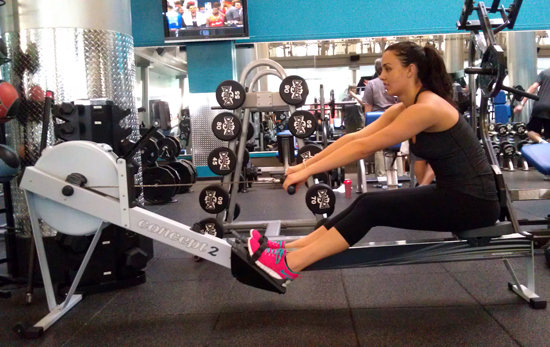
- Bring your knees up and slide to the top of the machine. Grab the handle using an overhand grip, but don't hold too tightly.
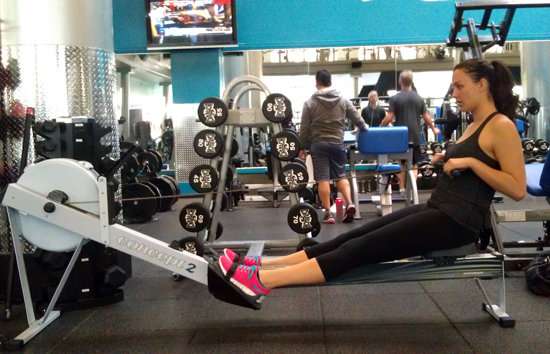
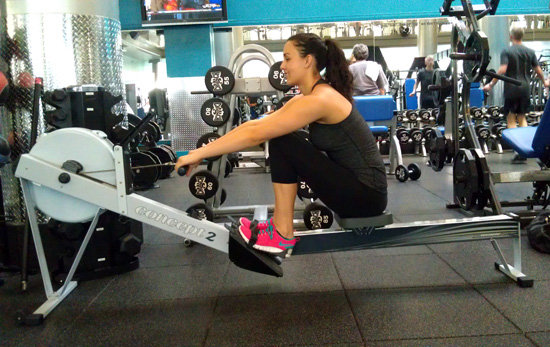
- Pull the handle with you as you slide to the end of the machine. Your legs should be straight, but knees should still have a slight bend in them so they aren't locked. Lean back slightly and pull your hands up to your chest, holding the handle so it is right below your breasts, with elbows pointing down against your sides. This is the position where you should begin your workout, and it's also your ending position once you complete a full stroke (see below).

The Catch
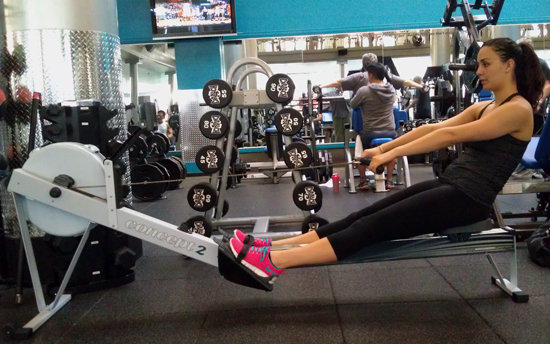
- Move your arms out first, followed by your upper body. Your back should always stay straight, not slumped, with shoulders back and abs engaged as you follow through. As your arms extend out, your upper body position will go from slightly angled back to slightly angled forward.

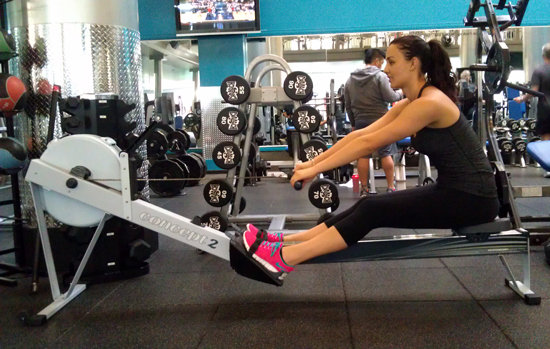
- As your arms extend and body leans forward, slide your body forward on the seat by bending your legs. Once you are at the top of the machine, your arms will be fully extended and legs will be bent (see below). This part of the stroke is called the catch.

The Drive
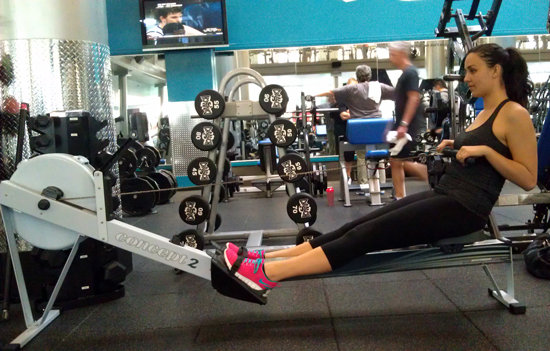
- To slide back to your finish position, push off with your feet first, so that your legs straighten but your arms are still extended and your body is still slightly leaning forward (see below). The drive is the part of the workout that mimics pulling the oars out of the water and propelling the boat forward, so it's this part that works your leg and core muscles the most.

- As you continue to push through with your legs, move your upper body so that you begin to lean back (see below).

- The last part of your body to return to finish position are your arms; as your upper body angles back, pull the handle and bend your arms so that the handle ends up back to touching the front of your chest, just like how you started (see below). Don't grip the handle too hard; the power should be through your legs, and using too much force while pulling the cable can cause hand blisters as well as back problems.
- Continue practicing your stroke slowly and at low resistance until you get the hang of it! It can be helpful to break the moves down into a sequence of what should move first: "arms-body-legs" as you pull up to the top of the machine and "legs-body-arms" as you push back.

You don't want to leave the majority of the work to your arms and upper body. Our legs are much stronger (generally) than our arms. Here are a few exercises to help increase your leg power.
Squat Thruster
Box Jumps
Tuck Jumps
Basically any plyometric leg exercise will work.
Hand Release Push Ups
Renegade Row
Pull Up
Plyometric Push Up
Now that you've got the strength, you need to work on your speed, and speed (or sprinting) endurance. The best way to do this is to actually practice sprinting, or excreting high levels of energy for extended periods of time. Here are a few of my favorite high intensity drills.
Tabata: This is a 4 minute interval, 20 seconds high intensity, and 10 seconds rest, repeated 8 times. You can do this with basically any exercise, be it running, riding a bike, squatting, push ups... Just remember the higher the intensity the better.
Circuit: There are several different ways that a circuit can be performed. My favorite is 30 seconds on and 3 second transition alternating between a resistance exercise (squats, push ups, planks...) and a high intensity cardio exercise (buprees, mountain climbers, tuck jumps...) Here is a great one for you.
Here is a more complete explanation of High Intensity Interval Training.
Remember to practice rowing at least a couple of times a week, and work in these other helpful exercises on the other days. Some days will naturally be easier than others, but don't get discouraged!
Subscribe to:
Posts (Atom)
When it Began:Why I thought I would love Yoga
When I began my yoga journey I was very interested in the things my physical body could do. I still am, to be honest, however my physical se...
-
I would love to tell you that I was one of "those" girls... you know the ones who you sit and watch eat a chocolate donut and t...
-
I found this chart and thought it was pretty interesting. Here in the US we have a real problem with obesity, and the number of children w...